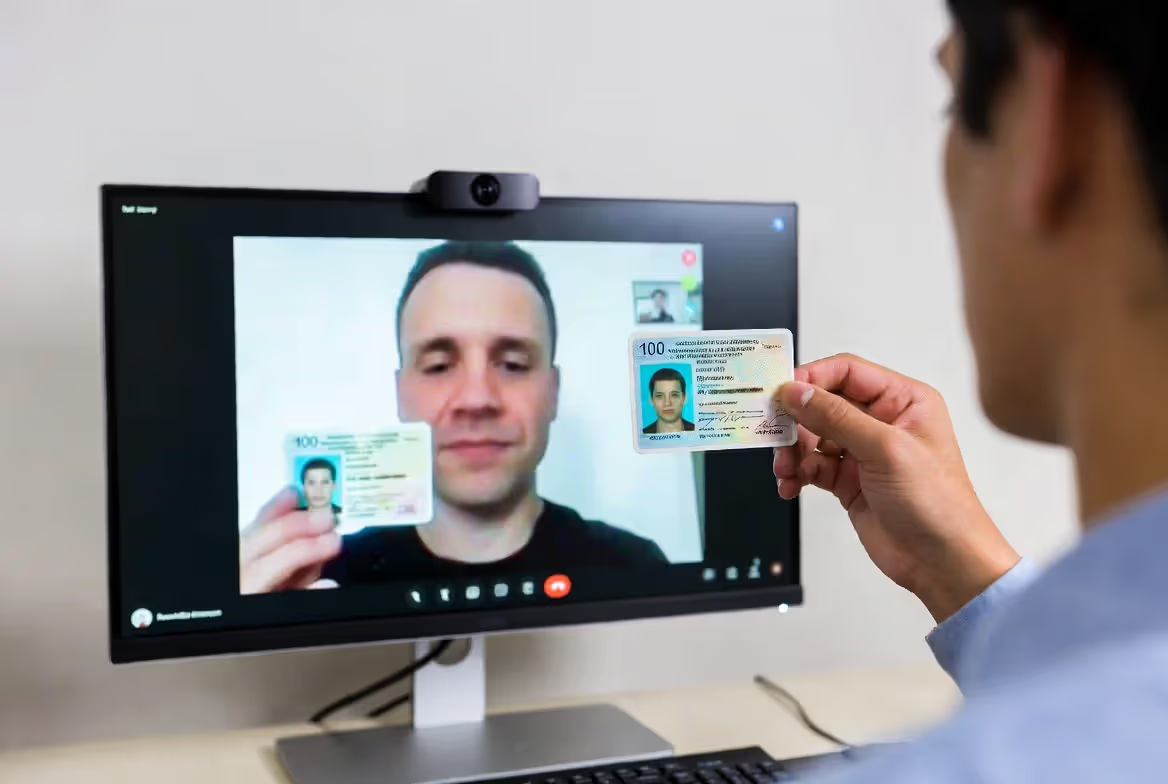
You're planning a wedding, possibly coordinating across state lines, and someone mentioned you should get a prenup. The idea of scheduling multiple appointments with expensive attorneys makes you groan. Good news: you don't have to. Digital platforms now handle prenuptial agreements from start to finish, and you'll never set foot in a law office.
But here's the catch—and it's a big one. Not every online service delivers a document that'll actually protect you. Some couples discover this the hard way, years into a divorce, when a judge tosses their agreement aside. We'll walk through what works, what doesn't, and how to avoid expensive mistakes.
What Is an Online Prenup and How Does It Work?
Think of an online prenup as getting your prenuptial agreement through your laptop instead of your lawyer's conference room. You're still creating the same legal document, just using digital channels: video consultations, cloud-based questionnaires, and electronic signing ceremonies.
Here's how most platforms operate. You start by filling out a detailed form about your money situation—what you own, what you owe, what you earn. The platform takes this information and builds a draft agreement. Depending on which service you pick, you'll either get connected with a licensed attorney who'll refine everything through video calls, or you'll receive a template that you customize yourself.
Compare that to the traditional route. You'd call an attorney's office, wait two weeks for an appointment, drive downtown during work hours, sit through an hour-long consultation, return for a second meeting to review the draft, coordinate with your partner's attorney for revisions, then schedule everyone—both lawyers, both of you, and a notary—for a final signing. The whole dance typically eats up six to eight weeks, minimum.
Digital platforms collapse this timeline dramatically. You complete your financial questionnaire over a weekend. An attorney reviews it and schedules a video call for Tuesday evening. You discuss your concerns over Zoom while wearing sweatpants. The draft arrives in your email by Friday. You sign through remote notarization the following week. Two weeks total, start to finish. (Though rushing it that fast is a mistake we'll cover later.)
Author: Aaron Whitfield;
Source: sbardellaorchards.com
The technology varies wildly between providers. Some use AI scanning tools that flag suspicious items in your financial disclosures—like if your reported bank balance doesn't match the statement you uploaded. Others maintain databases of state-specific legal requirements and automatically adjust your agreement based on where you live. Nearly all offer encrypted storage and will send you reminders when it's time to update your prenup after major life changes.
Are Online Prenups Legally Valid in the United States?
Let's cut through the confusion: yes, but validity depends entirely on whether your finished document satisfies your state's legal standards. Courts don't care whether you drafted your prenup on an iPad or in a mahogany-paneled law office. They care about the substance.
Every state demands certain basics. You both have to sign willingly—nobody holding a metaphorical gun to your head. You must disclose your finances completely; hide a bank account and the whole agreement might collapse. The document needs signatures, typically notarized. Pretty standard stuff.
The reason people worry about online prenup legality comes down to execution errors. A judge evaluates e-prenup enforceability using identical criteria whether you created it online or offline. A sloppy prenup drafted by a $500-an-hour attorney will fail just as fast as a bad online template. The difference is that expensive attorney might catch problems before you sign.
Author: Aaron Whitfield;
Source: sbardellaorchards.com
State variations complicate everything. California makes you wait seven days between receiving your final draft and signing—no exceptions. Texas gives you the right to consult separate attorneys but doesn't force you to. Florida judges scrutinize agreements extra carefully when only one party had legal counsel. Louisiana operates under civil law instead of common law, which means documents from other states often need significant modifications.
Some online platforms haven't caught up with these nuances. They'll sell you a one-size-fits-all template that technically works in Delaware but creates problems in Nevada. You've spent $400 on a document that won't survive a courtroom challenge.
The independent counsel issue trips up many couples. While most states won't invalidate your prenup simply because you shared an attorney, courts definitely prefer seeing both parties get separate legal advice. Picture this: you earn $300,000 annually, your fiancé earns $45,000, and your prenup requires them to waive all spousal support. If they didn't consult their own attorney, any decent divorce lawyer will attack that agreement. Some judges have ruled such prenups unconscionable, particularly when one person gave up substantial rights without understanding what they were signing.
Remote notarization laws keep evolving. Right now, 47 states accept remote online notarization (RON) for most documents. However, three states still insist on in-person notarization specifically for prenuptial agreements. If you're in one of those states, you'll complete everything else online but still need to meet a notary face-to-face for the signing ceremony.
A good marriage is one which allows for change and growth in the individuals and in the way they express their love
— Pearl S. Buck
Pros and Cons of Creating a Prenup Online
Online prenups deliver real benefits, but they're not the right solution for everyone. Let's break down both sides.
Pros
Cons
Wallet-friendly: Most services charge between $500 and $2,000, while traditional attorneys bill $3,000 to $10,000-plus for the same document
Cookie-cutter limitations: If you own multiple businesses, investment properties across several states, or complex trusts, templates might not cut it
Work in your pajamas: No commuting to appointments, no taking time off work, no waiting in reception areas with outdated magazines
Video calls miss nuances: An experienced attorney sitting across from you might notice your hesitation or ask follow-up questions that don't occur during a Zoom meeting
Quick turnaround: Many platforms deliver drafts in three to seven days versus two to four weeks with traditional firms
State law blind spots: Some platforms don't properly account for your state's specific requirements, creating enforceability problems down the road
Geographic flexibility: Couples living in different cities, rural areas without family law specialists, or anyone with mobility challenges can access quality legal help
Generic solutions: Templates struggle with unique situations like supporting elderly parents, protecting intellectual property, or handling inheritances from family businesses
Upfront pricing: You pay a flat fee and know exactly what it costs, unlike hourly billing that can spiral unpredictably
Scrutiny risk: Courts may examine your prenup more skeptically if only one of you consulted an attorney, especially if terms favor one party heavily
The convenience factor matters enormously for certain couples. You're planning a wedding while both working demanding jobs, maybe with kids from previous relationships in the mix. Finding time to visit a law office during business hours becomes nearly impossible. Working on your prenup at 10:30 p.m. after everyone's asleep? That actually works.
Cost savings look appealing until you consider the stakes. If your combined assets exceed $1 million, or either of you owns a business that could triple in value during your marriage, or you're bringing children from previous relationships into the equation—saving $5,000 on your prenup might cost you $100,000 in litigation when it fails. For couples with straightforward situations (both earn salaries, have retirement accounts, rent rather than own, no prior marriages), online platforms often provide solid protection for a fraction of traditional costs.
Accessibility extends beyond simple geography. Some people find law offices intimidating. Others have disabilities that make traveling to appointments difficult. A few simply communicate better when they can pause conversations, review information at their own pace, and avoid the pressure of face-to-face meetings.
But the reduced personal interaction means potentially missing important considerations. A skilled attorney meeting you in person might pick up on body language, ask probing questions about that side business you mentioned casually, or identify concerns you hadn't thought to raise. Video calls don't always capture these subtleties, and automated questionnaires definitely don't.
How to Sign a Prenup Remotely
Remote signing has become legally acceptable in most states, but mess up the procedure and you've invalidated your entire prenup.
Step one: Confirm your state permits remote notarization for prenuptial agreements. Even though 47 states allow RON generally, a few restrict it for specific documents. Your state's Secretary of State website should clarify this, or ask your online provider directly. Don't assume—verify.
Step two: Each person signs separately. Common mistake: couples think they can both appear on the same video call with one notary. Most states require individual acknowledgment sessions. You'll have your own appointment, your partner will have theirs.
Author: Aaron Whitfield;
Source: sbardellaorchards.com
Step three: Use a RON platform meeting your state's technology requirements. The notary must verify your identity through approved methods—usually analyzing your driver's license or passport, plus asking knowledge-based questions (like "which of these addresses did you live at in 2019?"). The video session gets recorded and stored, typically for five to ten years depending on state law.
Step four: Complete notarization during a live video session. You'll hold your government-issued ID up to your camera, answer identity verification questions, and verbally confirm you're signing voluntarily without pressure. The notary watches you apply your electronic signature, then adds their digital seal.
Step five: Download certified copies immediately. After notarization finishes, save multiple copies. Some states require filing the agreement with your county clerk; others don't. Store copies securely but separately from your spouse—keep one in a safe deposit box only you can access, or with your attorney. If you divorce, you'll need to produce the signed original.
Witness requirements add another layer. Several states require two witnesses plus notarization for prenuptial agreements. These witnesses can join remotely in most RON-friendly states, but they need separate video connections from you and from each other.
Timing is critical. Judges have invalidated prenups signed one week before weddings, reasoning that the approaching wedding date created pressure. Plan to complete remote signing at least 30 days before your wedding, preferably 60 to 90 days out. This demonstrates you both had plenty of time to consider the agreement without feeling rushed.
Creating a prenup without meeting your attorney face-to-face is perfectly legal, but it demands more discipline from you. You must gather and upload complete financial documentation—bank statements going back months, investment account summaries, property deeds, business valuations, credit card balances, loan documents. Missing even one account can void everything. Block off several hours to collect and scan documents, and verify your partner has done likewise before anyone signs anything.
Online Prenup Services vs. DIY Prenup Platforms
The online prenup marketplace splits into two distinct types: full-service platforms that connect you with attorneys, and DIY template sites that provide software but minimal legal guidance.
Full-service platforms pair you with licensed attorneys in your state who either draft your prenup from scratch or heavily customize a template. You complete an intake form, then schedule video consultations where the attorney explains options, answers your questions, and tailors the agreement to your situation. The attorney ensures state-specific compliance, suggests provisions you might overlook, and often coordinates your notarization appointment. Expect to pay $1,200 to $2,500.
DIY platforms offer templates and document assembly software. You answer a series of questions, algorithms generate a prenup based on your answers, and you receive a finished document. Some offer optional attorney review as an add-on, but the base service provides no lawyer interaction. These run $150 to $600.
Feature
Full-Service Platform
DIY Template Platform
Attorney consultation
Included (usually one to three video sessions)
Not part of base service (sometimes available as paid upgrade)
Tailored to your state
Yes—attorney customizes language to comply with local laws
Limited; templates might include basic state variations
Handles complex finances
Can address business ownership, trusts, complicated asset structures
Works best when both parties have simple finances
Separate counsel for each party
Some platforms assign different attorneys to each person
No attorneys provided; you'd hire your own separately
Revisions and reviews
Multiple revision rounds typically included
Limited or nonexistent; changes may trigger additional fees
Notarization assistance
Platform often arranges RON appointments
You coordinate this yourself
Price range
$1,200 to $2,500
$150 to $600
Timeline from start to finish
Two to four weeks
One to three days (longer if you arrange separate attorney review)
When you're evaluating online prenup service reviews, ask these questions: Does the attorney hold a current license in your specific state? Will each of you work with different attorneys, or at minimum does the service recommend hiring separate counsel? What's included in the advertised price versus what costs extra? Does the platform handle notarization, or are you on your own? What's the revision policy if you need changes after seeing the initial draft?
DIY tools make sense for couples with uncomplicated finances. You're both employees earning salaries. You've got 401(k) accounts and modest savings. Neither of you owns property or a business. You don't have kids from previous relationships. You simply want to keep your individual retirement accounts separate if you divorce. A template can probably handle that—assuming you pay an attorney $300 to review it before signing.
Full-service platforms become necessary when complications enter the picture. One of you owns a business. Someone has significant premarital assets. You're buying a house together before the wedding. Either of you has children from an earlier marriage. One person has substantial debt the other doesn't want to inherit. The attorney consultation helps you anticipate scenarios you wouldn't think of alone, like what happens if one of you receives a $500,000 inheritance from a grandparent mid-marriage.
DIY platforms tempt people into overconfidence. They assume the template accounts for their state's requirements because the website said it covers "all 50 states." Software can't replace legal judgment. Your DIY prenup might address property division perfectly but omit mandatory language about spousal support, making the entire document unenforceable under your state's law.
Common Mistakes When Using an Online Prenup Service
Even attorney-assisted platforms don't prevent every error. Couples regularly make choices that jeopardize enforceability.
Sharing one attorney when you need two. Your online service provides a single attorney who consults with both of you. Better than nothing, sure. But it's not independent counsel. Courts give substantially more weight to prenups where each person consulted their own attorney. At minimum, hire a separate attorney in your state to review the final document before signing. This review typically costs $300 to $800 and might prevent a $75,000 problem later.
Ignoring where you'll actually live. You're getting married in Hawaii but moving to Colorado afterward. Your online platform's attorney is licensed in Hawaii and uses Hawaii-compliant language. Problem: Colorado law will govern your prenup if that's where you establish residency. Verify the drafting attorney is licensed in the state where you'll live, not just where you're celebrating.
Incomplete financial disclosure. Courts routinely invalidate prenups when one party concealed assets or "forgot" to mention debts. Online platforms provide checklists of required documents—bank statements, investment summaries, property deeds, loan agreements, credit card balances. Don't skip items because they seem insignificant. That $4,000 credit card debt or $12,000 remaining on your car loan must be disclosed.
Treating your prenup as a one-time document. You sign in 2026. By 2031, you've had three kids, purchased two homes, and launched a successful business. Your prenup says nothing about any of this. Most prenups include provisions addressing future property, but these provisions are often vague. Review your agreement every three to five years, especially after major changes like births, inheritance, business formation, or real estate purchases. Many online platforms offer update services at reduced rates for returning clients.
Author: Aaron Whitfield;
Source: sbardellaorchards.com
Signing under the wire. You signed four days before your wedding ceremony, after sending invitations and paying deposits on your venue and caterer. A judge might view this timing as coercive—you felt pressured to sign rather than cancel the wedding and lose money. Complete your prenup at least 30 days before your wedding date, ideally two to three months out.
Believing electronic signatures always work. The ESIGN Act and state equivalents make e-signatures valid for most contracts. However, some states impose specific formalities for prenuptial agreements. A handful of jurisdictions still require wet ink signatures or in-person notarization. Don't assume your platform's default e-signature process meets your state's particular requirements.
Losing your executed document. After remote signing, you download the finished prenup and... save it where? Some couples save it on a shared computer, where it gets deleted in a spring cleaning three years later. Others email it to themselves and forget which email account. If you divorce and can't produce the signed original, the other party might claim it was never properly executed. Store multiple copies in secure, separate locations—one in a safe deposit box under your name alone, another with your attorney, maybe a third in encrypted cloud storage.
Skipping independent counsel even when it's not mandatory. Your state doesn't require separate attorneys, so you don't bother. But your prenup asks your lower-earning partner to waive spousal support entirely. Without independent counsel, this becomes extremely vulnerable to challenge. Budget for at least a consultation with your own attorney, even if you use an online service for drafting.
Common Questions About Online Prenups
How much does an online prenup cost?
DIY templates start around $150, though you're getting basically no legal guidance at that price point. Quality online services with attorney involvement run $1,200 to $1,800 for most couples. Add another $300 to $800 per person if you each want an independent attorney to review the finished document—which you should. Remote notarization appointments cost $25 to $75 per person. Compare this to traditional attorney-drafted prenups at $3,000 to $10,000 or more, depending on how complicated your finances are and where you live. Manhattan attorneys charge more than attorneys in Omaha.
Can I create a prenup without meeting a lawyer in person?
Absolutely. The entire process can happen virtually—video consultations, document sharing through encrypted portals, signing via remote notarization. Most states permit this approach for prenuptial agreements as of 2026. That said, some experienced family law attorneys argue that in-person meetings facilitate better communication and more thorough counseling. If your financial situation is complex or your prenup involves waiving significant rights, consider at least one face-to-face meeting even if you handle everything else remotely.
Will my online prenup hold up in court?
Your online prenup is enforceable if it satisfies your state's legal requirements: voluntary signing by both parties, complete financial disclosure, proper written format, correct execution procedures (signatures and notarization), and substantively fair terms. How you created the document—online versus in a law office—doesn't determine enforceability. However, online prenups face higher risk of procedural mistakes if the platform doesn't properly account for your state's specific rules or if you skip independent legal review. Courts evaluate the finished document, not your method of production.
Do we both need our own attorneys for an online prenup?
Most states don't legally mandate separate attorneys, but having independent counsel dramatically strengthens enforceability. Some online platforms provide one attorney serving both parties; others connect each person with their own attorney. If your online service offers just one attorney, strongly consider hiring a second attorney independently to review everything before you sign. This becomes especially important if the prenup heavily favors one party or if either person is waiving substantial rights like spousal support.
How long does the online prenup process take?
DIY platforms can generate a template in minutes, but signing immediately would be foolish. Full-service online platforms typically need two to four weeks from initial questionnaire to final notarized document. This timeline includes attorney review, revision rounds, and scheduling remote notarization. Allow extra time if you're gathering financial documents or hiring independent attorneys for review. Start the process 60 to 90 days before your wedding to avoid any appearance of pressure and to give both of you adequate time for thoughtful consideration.
Which states allow remote notarization for prenups?
Forty-seven states currently permit remote online notarization for at least some legal documents, and most of these states allow RON for prenuptial agreements specifically. Three states still require in-person notarization for prenups as of 2026, though these laws continue evolving. Check your state's Secretary of State website or ask your online prenup provider to confirm current requirements. Even in RON-enabled states, the notary must hold a commission in your state or in a state that has reciprocity agreements with yours.
Online prenups deliver genuine value for couples with straightforward finances who want asset protection without the cost and time commitment traditional legal services demand. The virtual prenup process has matured considerably—better technology, more experienced attorneys, clearer legal frameworks for remote notarization.
But don't let convenience override caution. Your online prenup is only as good as the platform you choose and the effort you invest understanding your state's requirements. If your situation involves business ownership, substantial assets, children from earlier marriages, or significant income disparity between you and your partner, the money saved on an online service might prove a false economy. Complex estates need personalized legal counsel, not templates optimized for the masses.
For couples choosing the online route, success hinges on three factors: selecting a reputable platform with state-licensed attorneys who understand your jurisdiction, ensuring both parties receive independent legal review, and completing the process with adequate breathing room before the wedding. Skip any of these elements and your prenup might not survive judicial scrutiny.
Whether your digital prenuptial agreement holds up in court ultimately depends not on the technology used to create it, but on whether you followed your state's substantive and procedural requirements. An online prenup executed properly carries the same legal weight as one drafted in a mahogany-paneled law firm—and one created carelessly will fail regardless of its origin.
A prenuptial agreement is a legal contract signed before marriage that clarifies financial expectations and protects individual interests. This guide explains what prenups cover, why couples get them, how they're created, and answers common questions in plain language
Retirement accounts often represent the largest marital assets after the family home. When a marriage ends, these accounts must be divided fairly—but unlike splitting a bank account, dividing pensions and 401(k)s requires specialized legal paperwork. A single mistake can trigger tens of thousands in taxes or lost benefits
Dividing retirement assets during divorce involves more than simply splitting an account balance in half. For most employer-sponsored retirement plans, you need a specialized court order called a Qualified Domestic Relations Order—commonly known as a QDRO
Prenuptial and postnuptial agreements define financial rights during marriage and divorce. Learn the differences between postnup vs prenup, legal requirements, enforceability factors, typical costs, and when these marital agreements make sense for your situation
The content on this website is provided for general informational and educational purposes only. It is intended to explain concepts related to family law, divorce, custody, child support, and related legal matters.
All information on this website, including articles, guides, and examples, is presented for general educational purposes. Legal processes may vary depending on jurisdiction, personal circumstances, and applicable laws.
This website does not provide legal advice, and the information presented should not be used as a substitute for consultation with qualified family law attorneys or legal professionals.
The website and its authors are not responsible for any errors or omissions, or for any outcomes resulting from decisions made based on the information provided on this website.