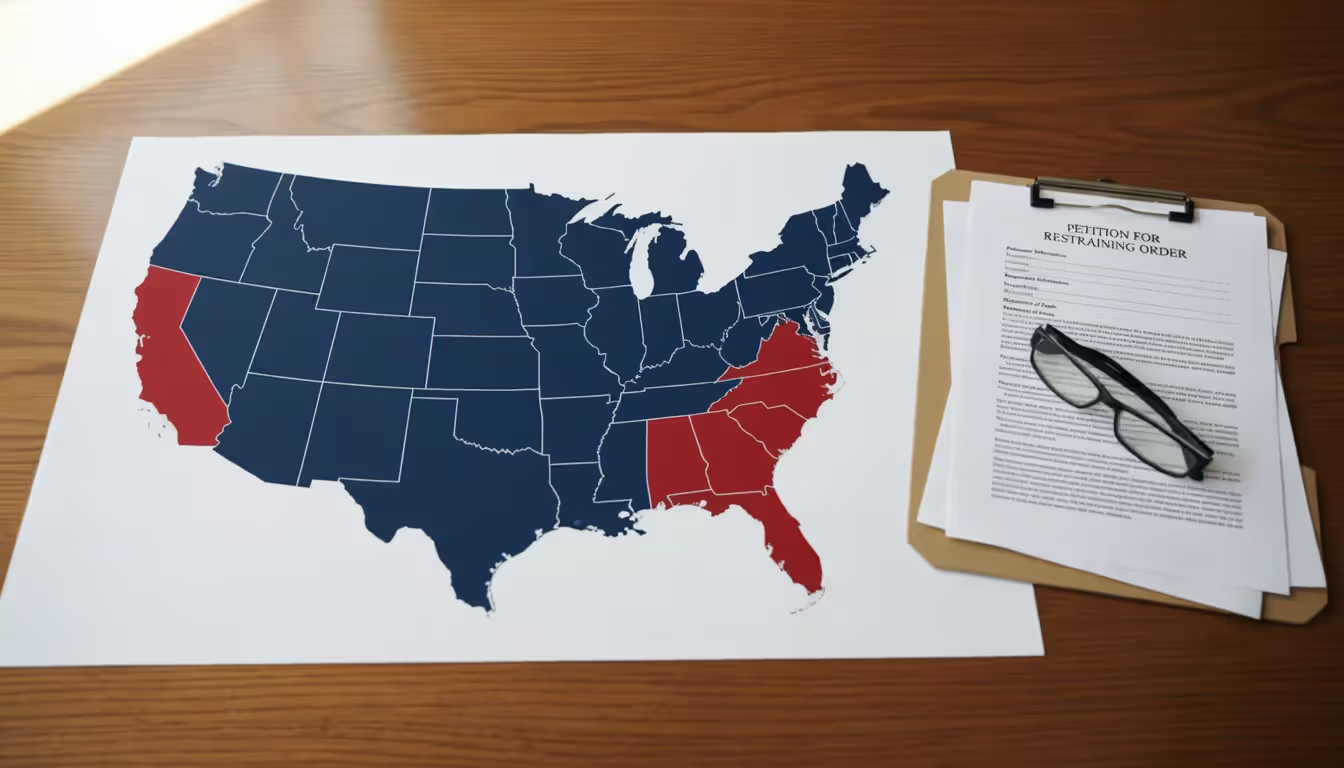
Adultery complicates divorce proceedings, but whether it destroys your eligibility for alimony depends entirely on where you file. Some states treat infidelity as a complete bar to spousal support, while others ignore it entirely. Understanding your state's approach to marital fault can mean the difference between receiving financial support and walking away with nothing.
How Adultery Affects Alimony in the United States
The United States operates under a patchwork of divorce laws that vary dramatically by jurisdiction. Roughly half the states maintain fault-based divorce options alongside no-fault procedures, while the remaining states function as pure no-fault jurisdictions.
In fault-based divorce states, adultery and alimony remain connected through statutes that allow judges to consider marital misconduct when awarding spousal support. These laws reflect traditional views that a spouse who violates marital vows shouldn't benefit financially from the dissolution. Courts in these jurisdictions may reduce, deny, or condition alimony awards based on proven infidelity.
No-fault states take the opposite approach. California, for example, explicitly prohibits judges from considering adultery when determining spousal support. These jurisdictions focus exclusively on financial need, earning capacity, and the marital standard of living. The reasoning: divorce already dissolves the marriage; punishing adultery through alimony serves no legitimate legal purpose.
The distinction between fault and no-fault systems creates wildly different outcomes for unfaithful spouses. A cheating spouse in Georgia might receive nothing, while an identical fact pattern in Washington State would result in standard spousal support calculations with no penalty whatsoever.
Burden of proof matters significantly in fault states. The innocent spouse must typically demonstrate adultery through clear and convincing evidence—not mere suspicion or circumstantial inference. Text messages, photographs, hotel receipts, and witness testimony commonly serve as proof. Some states require corroboration beyond the testimony of the spouses themselves.
Author: Aaron Whitfield;
Source: sbardellaorchards.com
States Where Cheating Bars or Reduces Alimony
Several states maintain statutes explicitly addressing adultery's impact on spousal support. These fault-based jurisdictions give judges discretion to deny alimony entirely or reduce awards based on proven infidelity.
North Carolina stands out with particularly strict rules. Under North Carolina General Statute § 50-16.3A, a dependent spouse who participated in an illicit sexual relationship before separation is barred from receiving alimony unless the supporting spouse also committed adultery or the court finds that denying alimony would create "manifest injustice." This creates a high bar for unfaithful spouses seeking support.
Georgia law allows judges to consider adultery as a factor in alimony determinations. Georgia Code § 19-6-1(b) permits courts to deny alimony to spouses whose adultery caused the separation. The innocent spouse must prove both the affair and its causal connection to the marriage breakdown. Georgia courts have denied alimony even when the unfaithful spouse had significant financial need.
South Carolina takes a middle approach. While adultery doesn't automatically bar alimony, South Carolina Code § 20-3-130 prohibits alimony to spouses who committed adultery before the filing or final order of separate maintenance and support. Courts maintain discretion to consider the totality of circumstances, including comparative fault.
Complete State-by-State Breakdown
State
Fault/No-Fault Status
Adultery Impact on Alimony
Key Legal Standard
North Carolina
Fault available
Complete bar unless manifest injustice
N.C. Gen. Stat. § 50-16.3A
Georgia
Fault available
May deny based on causation
Ga. Code § 19-6-1(b)
South Carolina
Fault available
Bar if adultery before filing
S.C. Code § 20-3-130
Virginia
Fault available
Bar or reduction possible
Va. Code § 20-107.1
Florida
Fault available
Consideration factor
Fla. Stat. § 61.08
Texas
Fault available
Discretionary consideration
Tex. Fam. Code § 8.052
Tennessee
Fault available
Statutory factor
Tenn. Code § 36-5-121
Alabama
Fault available
Bar in some circumstances
Ala. Code § 30-2-57
Louisiana
Fault available
May deny to at-fault spouse
La. Civ. Code art. 112
Utah
Fault available
Discretionary factor
Utah Code § 30-3-5
California
No-fault only
No impact
Cal. Fam. Code § 4320
Washington
No-fault only
Not considered
RCW 26.09.090
Oregon
No-fault only
Irrelevant
ORS 107.105
Colorado
No-fault only
Not a factor
C.R.S. § 14-10-114
Wisconsin
No-fault only
No consideration
Wis. Stat. § 767.56
What Counts as Adultery in Fault States
Legal definitions of adultery vary, but most fault states define it as voluntary sexual intercourse between a married person and someone other than their spouse. The key elements include:
Voluntary participation: Rape or coerced sexual contact doesn't constitute adultery. The unfaithful spouse must have engaged willingly.
Sexual intercourse: Most states require proof of actual intercourse. Emotional affairs, kissing, or other intimate conduct typically falls short of the legal definition, though some jurisdictions have expanded definitions to include "deviate sexual conduct."
During the marriage: The affair must occur while the parties remain legally married. Sexual relationships after separation may not qualify, depending on state law and separation date definitions.
With a person other than the spouse: This seems obvious but matters in cases involving open marriages or consensual non-monogamy, where some courts have found no adultery occurred.
Proof requirements create practical challenges. Direct evidence rarely exists, so courts accept circumstantial evidence showing opportunity and inclination. A spouse who spent the night in a hotel room with someone other than their partner, combined with affectionate text messages, typically satisfies the burden of proof.
Author: Aaron Whitfield;
Source: sbardellaorchards.com
States Where Infidelity Does Not Affect Spousal Support
Pure no-fault states reject marital misconduct as relevant to alimony determinations. These jurisdictions view spousal support as an economic remedy, not a punishment for moral failings.
California pioneered no-fault divorce in 1970 and maintains strict prohibitions against considering adultery. California Family Code § 4320 lists 14 factors for determining spousal support, and marital misconduct appears nowhere on the list. California courts have explicitly rejected attempts to reduce alimony based on infidelity, finding such considerations contrary to legislative intent.
Washington State follows similar principles. RCW 26.09.090 directs courts to consider only financial factors: the financial resources of each party, the time necessary to acquire education or training, the standard of living during marriage, the duration of marriage, and each spouse's age and health. Does cheating affect alimony in Washington? Absolutely not—judges lack authority to consider it.
Oregon, Colorado, Wisconsin, and several other states maintain comparable approaches. These jurisdictions recognize that fault-based considerations introduce unpredictability, increase litigation costs, and prolong divorce proceedings. By focusing exclusively on financial equity, no-fault states aim to reduce conflict and provide consistent outcomes.
Community property states (California, Washington, Idaho, Nevada, Arizona, New Mexico, Texas, Louisiana, and Wisconsin) generally align with no-fault principles, though Texas and Louisiana maintain fault-based options. Even in these hybrid states, the trend moves toward separating moral judgments from financial awards.
Unfaithful spouse support rights remain fully protected in no-fault jurisdictions. A dependent spouse who committed adultery receives the same alimony consideration as an innocent spouse with identical financial circumstances. The affair might devastate the marriage emotionally, but it carries no legal consequence for spousal support.
When Marital Misconduct Matters Beyond Adultery
Even in no-fault states, certain conduct related to adultery can impact divorce settlements. Courts distinguish between the affair itself and financial misconduct connected to the relationship.
Dissipation of marital assets: Spending marital funds on an affair partner creates grounds for adjustment in property division. If a spouse spent $30,000 on gifts, trips, and rent for a paramour, courts in no-fault states can reimburse the innocent spouse from the unfaithful spouse's share of marital property. This isn't punishment for adultery—it's reimbursement for misappropriated marital funds.
Economic impact: When an affair causes job loss, business failure, or other financial harm, courts may consider these economic consequences when calculating need and ability to pay. A spouse fired for conducting an affair with a subordinate might find their earning capacity assessment affected by their own misconduct.
Abandonment: Leaving the marital home to live with an affair partner can constitute abandonment in some states. While the affair itself might not affect alimony, abandonment could serve as an independent fault ground with alimony consequences.
Abuse and neglect: Emotional abuse related to flaunting an affair, or neglecting children due to an extramarital relationship, may factor into custody and, indirectly, support calculations.
How cheating affects divorce settlement often depends less on the affair itself and more on surrounding circumstances. A discreet affair with no financial impact plays out differently than one involving lavish spending, public humiliation, or child neglect.
Author: Aaron Whitfield;
Source: sbardellaorchards.com
How Courts Decide Alimony When Cheating Is Involved
In fault states where adultery matters, judges balance multiple factors rather than automatically denying support. Alimony and fault in divorce intersect through a multi-factor analysis.
Length of marriage: Long marriages typically generate stronger alimony claims, even for unfaithful spouses. A 25-year marriage where adultery occurred in the final year might still result in substantial support, particularly if the dependent spouse sacrificed career opportunities during the marriage.
Financial need and ability to pay: Courts prioritize economic reality. A spouse with no income and no job prospects might receive support despite adultery if denying alimony would leave them destitute. Conversely, a financially independent spouse who had an affair has little claim to support regardless of fault rules.
Earning capacity: Educational background, work history, and employability affect awards more than misconduct in most cases. A spouse with a medical degree who committed adultery will receive less sympathy than a spouse who left the workforce for 20 years to raise children.
Standard of living: Courts attempt to maintain the marital standard of living for both parties when possible. Adultery might reduce the unfaithful spouse's award but rarely eliminates consideration of this factor entirely.
Comparative fault: When both spouses engaged in misconduct, courts often neutralize fault considerations. Mutual adultery typically results in treating the case as if neither party committed adultery.
Causation: Some states require proof that adultery caused the marriage breakdown. If the marriage was already failing due to other factors, adultery might carry less weight.
Real cases illustrate these principles. In a 2023 Virginia case, a court reduced but didn't eliminate alimony for a wife who had an affair during a 15-year marriage where she had been the primary caregiver for disabled children. The judge found that denying all support would be inequitable given her caregiving contributions and limited job prospects.
Contrast this with a 2025 Georgia decision where a husband who abandoned his wife for his secretary after a seven-year marriage received no alimony despite earning less. The court found his adultery directly caused the divorce and occurred relatively early in the marriage, limiting his equitable claim to support.
Author: Aaron Whitfield;
Source: sbardellaorchards.com
Your Rights as an Unfaithful Spouse Seeking Support
Navigating alimony as the unfaithful spouse requires strategic decisions and realistic expectations.
Disclosure timing: Some attorneys advise disclosing adultery early in settlement negotiations to avoid costly discovery and demonstrate good faith. Others recommend forcing the opposing party to prove it, particularly when evidence is weak. The right approach depends on the strength of evidence and your state's laws.
Settlement vs. trial: Settling avoids the risk of a judge applying maximum fault-based penalties. Many unfaithful spouses accept lower alimony in settlement than they might receive at trial to avoid uncertainty and publicity.
Rehabilitation vs. permanent support: Focus arguments on rehabilitative alimony—time-limited support while you gain job skills or education. Courts more readily award rehabilitative support to unfaithful spouses than permanent maintenance.
Document non-financial contributions: Evidence of homemaking, childcare, or supporting the other spouse's career can counterbalance adultery. These contributions created economic value regardless of the affair.
Avoid inflammatory conduct: Continuing the affair during divorce proceedings, flaunting the relationship, or introducing the affair partner to children can worsen outcomes. Courts notice this behavior.
Consider mediation: Mediators focus on practical solutions rather than moral judgments. Mediation often produces better results for unfaithful spouses than litigation.
Understand your state's specific rules: Cheating spouse alimony rights vary dramatically. Consult an attorney familiar with local case law and judicial tendencies. Some counties within fault states treat adultery more harshly than others.
Prepare for reduced awards: Even with strong financial need, expect less than you would have received without the affair. Budget accordingly and plan for financial independence.
Modern courts increasingly recognize that alimony serves to address economic disparity, not to punish moral failings. While adultery remains relevant in some jurisdictions, judges generally focus on financial factors and view fault as one consideration among many rather than a disqualifying event
— Jennifer Morrison
Common Questions About Cheating and Alimony (FAQ)
Can I still get alimony if my spouse also cheated?
Yes, mutual adultery typically neutralizes fault considerations. Most fault-based states treat cases with mutual infidelity similarly to no-fault divorces for alimony purposes. If both spouses had affairs, neither can claim moral superiority, and courts default to financial factors. Some states have explicit "recrimination" doctrines preventing either party from using fault grounds when both engaged in misconduct.
Do I have to prove adultery to deny alimony to my spouse?
In fault states where adultery affects alimony, yes—you must prove it through admissible evidence. Suspicion isn't enough. You'll need text messages, photographs, witness testimony, hotel records, or other concrete proof. The burden of proof typically requires "clear and convincing evidence," a higher standard than "preponderance of the evidence" used in most civil matters. Hiring a private investigator is common but expensive. Weigh the cost of proving adultery against the potential alimony savings.
Does a prenuptial agreement override adultery laws?
Prenuptial agreements can address alimony and adultery, but enforceability varies by state. A prenup stating "no alimony if either party commits adultery" is generally enforceable in both fault and no-fault states, though courts scrutinize such provisions for fairness. Some states won't enforce prenup provisions that leave a spouse destitute. A well-drafted prenup can provide more certainty than relying on state fault laws, which give judges broad discretion.
Can cheating affect child custody or child support?
Adultery rarely affects child custody unless it directly impacted the children—for example, exposing them to inappropriate situations or neglecting them during the affair. Child support follows state guideline formulas based on income and parenting time, not marital conduct. Courts separate parental fitness from spousal fidelity. However, if an affair partner has a criminal record or substance abuse issues and the parent introduces them to the children prematurely, custody could be affected.
How long do I have to report adultery in my divorce case?
Timing requirements vary by state. Some states require raising fault grounds in the initial divorce petition or response. Others allow amendments to pleadings before trial. In North Carolina, adultery must have occurred before separation to bar alimony. Waiting too long to raise adultery can result in waiving the issue. Additionally, some states have "condonation" doctrines—if you knew about the affair and continued living with your spouse, you may have forgiven it legally and can't later use it as grounds.
Will my alimony be reduced if I had an affair after separation?
This depends on how your state defines the relevant time period. Many states only consider adultery that occurred during the marriage and before separation. Post-separation relationships typically don't qualify as adultery because the marital relationship has already ended. However, state definitions of "separation" vary. Some require physical separation; others recognize legal separation while still living together. If you had an affair after filing for divorce but before the final decree, treatment varies by jurisdiction. Check your specific state's law on the relevant time period for adultery.
Adultery complicates divorce emotionally and legally, but it doesn't necessarily eliminate your right to spousal support. Your state's approach to fault determines whether the affair matters at all. In pure no-fault states, infidelity is legally irrelevant to alimony—you'll be evaluated solely on financial factors. In fault-based states, adultery can reduce or eliminate support, but judges still consider the full picture: marriage length, financial need, earning capacity, and contributions to the marriage.
If you committed adultery, focus on your financial circumstances and non-monetary contributions rather than trying to excuse the affair. If your spouse cheated, understand that proving adultery requires solid evidence and consider whether the cost of litigation justifies the potential alimony savings. Many cases settle with compromises that acknowledge the affair without fully applying maximum fault-based penalties.
Regardless of your situation, consult a family law attorney in your jurisdiction. Alimony law remains highly state-specific, and local court practices often matter as much as statutes. An experienced attorney can assess how local judges typically handle adultery cases and help you set realistic expectations.
The intersection of infidelity and spousal support reflects broader tensions in family law between traditional moral judgments and modern economic realities. As courts continue evolving toward no-fault principles, the trend favors separating financial remedies from marital misconduct. But for now, where you file matters as much as what you did.
A prenuptial agreement is a legal contract signed before marriage that clarifies financial expectations and protects individual interests. This guide explains what prenups cover, why couples get them, how they're created, and answers common questions in plain language
Retirement accounts often represent the largest marital assets after the family home. When a marriage ends, these accounts must be divided fairly—but unlike splitting a bank account, dividing pensions and 401(k)s requires specialized legal paperwork. A single mistake can trigger tens of thousands in taxes or lost benefits
Dividing retirement assets during divorce involves more than simply splitting an account balance in half. For most employer-sponsored retirement plans, you need a specialized court order called a Qualified Domestic Relations Order—commonly known as a QDRO
Prenuptial and postnuptial agreements define financial rights during marriage and divorce. Learn the differences between postnup vs prenup, legal requirements, enforceability factors, typical costs, and when these marital agreements make sense for your situation
The content on this website is provided for general informational and educational purposes only. It is intended to explain concepts related to family law, divorce, custody, child support, and related legal matters.
All information on this website, including articles, guides, and examples, is presented for general educational purposes. Legal processes may vary depending on jurisdiction, personal circumstances, and applicable laws.
This website does not provide legal advice, and the information presented should not be used as a substitute for consultation with qualified family law attorneys or legal professionals.
The website and its authors are not responsible for any errors or omissions, or for any outcomes resulting from decisions made based on the information provided on this website.